
 English
 Русский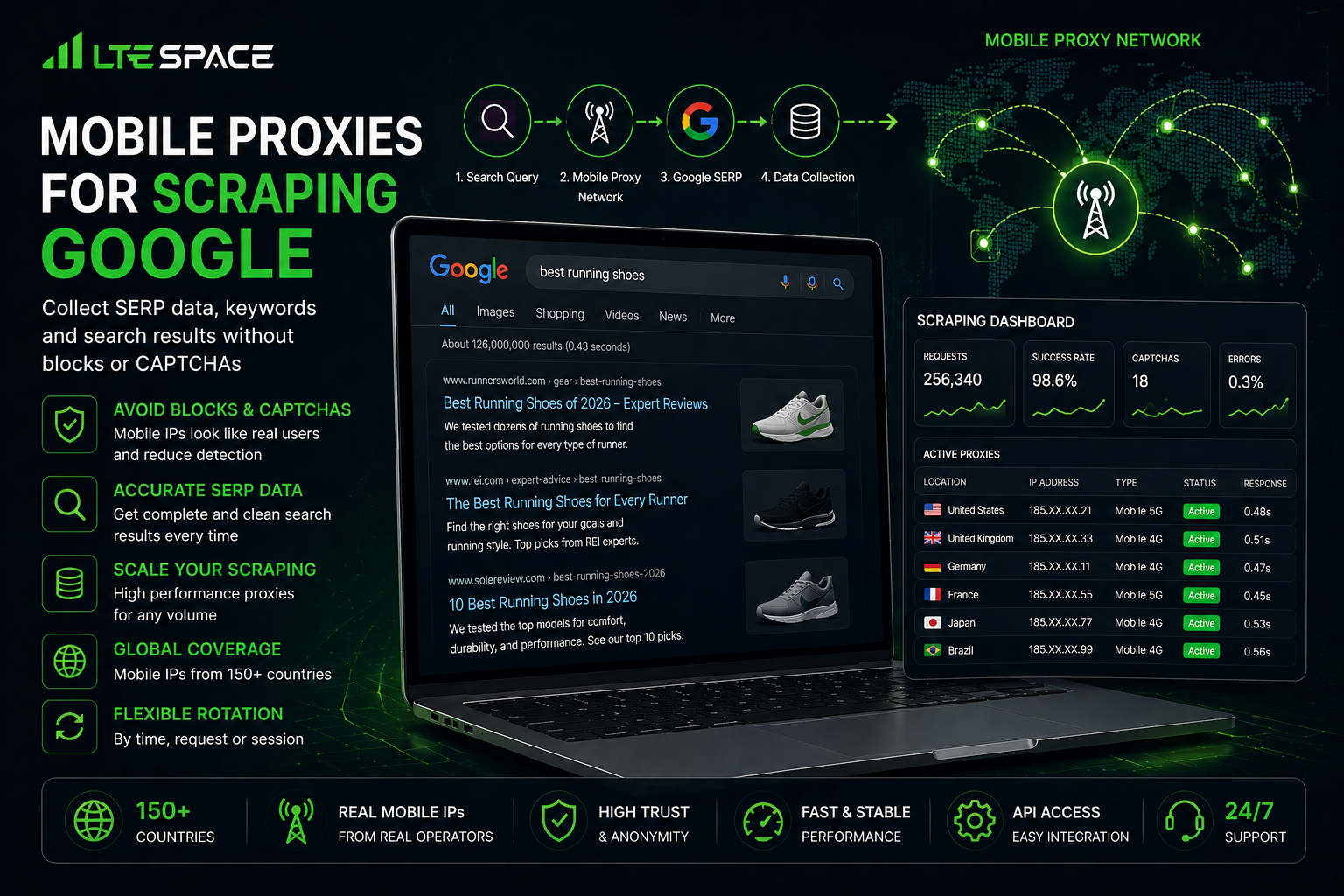
Mobile proxies for scraping Google are used to collect search results, keywords, and SERP data without blocks or distortions. When sending multiple requests, Google quickly applies restrictions to standard IPs, which makes stable data collection difficult without proper proxy infrastructure.
For scraping tasks, accuracy is critical. If traffic is detected as automated, parts of the data may be hidden, altered, or completely inaccessible. Mobile IPs reduce this effect and allow more consistent data extraction.
Problems of scraping Google without mobile proxies
Google scraping is highly sensitive to request patterns and IP reputation. Even a moderate number of requests can trigger restrictions.
Common issues include:
- frequent CAPTCHAs;
- temporary or permanent IP blocks;
- request rate limitations;
- incomplete search results;
- distorted SERP data;
- dependency on IP reputation.
Datacenter proxies are especially vulnerable to these issues. As a result, collected data becomes unreliable and requires constant IP rotation.
For comparison, see difference between mobile and datacenter proxies
How mobile proxies for scraping Google work
Mobile proxies for scraping Google route traffic through IP addresses assigned by mobile network operators. This type of traffic appears closer to real user behavior, which reduces the chance of detection.
Google evaluates multiple signals:
- network type and ASN;
- geolocation;
- request frequency;
- behavioral patterns;
- request sequence;
- language and region.
Mobile networks often use CGNAT, meaning multiple users share a single external IP. This increases trust but requires controlled usage.
More details: what is CGNAT in mobile proxies
Where mobile proxies are used in Google scraping
Mobile proxies for scraping Google are applied in several scenarios.
SERP data collection
Extract search results for target queries.
Keyword research
Collect suggestions and related keywords.
Competitor analysis
Analyze titles, descriptions, rankings, and SERP structure.
SEO data pipelines
Build datasets for automation and analytics tools.
SERP monitoring
Track changes across regions and time.
Practical use of mobile proxies for scraping Google
Stable scraping requires not only mobile IPs but also proper request logic.
Key practices:
- limit request frequency;
- add delays between requests;
- avoid repetitive patterns;
- separate tasks by region;
- use different user agents;
- monitor errors and CAPTCHAs.
Without these measures, even mobile IPs can be restricted.
Scaling Google scraping tasks
As data volume grows, load distribution becomes critical. Concentrating requests on a single IP leads to faster blocking.
Best practices:
- split workloads into streams;
- assign tasks to dedicated IPs;
- use controlled rotation;
- monitor request volume;
- distribute by region.
For scalable setups, see multiport mobile proxies
Conclusion
Mobile proxies for scraping Google provide a more stable and reliable way to collect SERP data, keywords, and search results. They reduce blocks and improve data accuracy.
However, performance depends on proper configuration. Request timing, rotation logic, and workload distribution are essential. When used correctly, mobile IPs significantly outperform datacenter proxies for scraping tasks.