English
 Русский
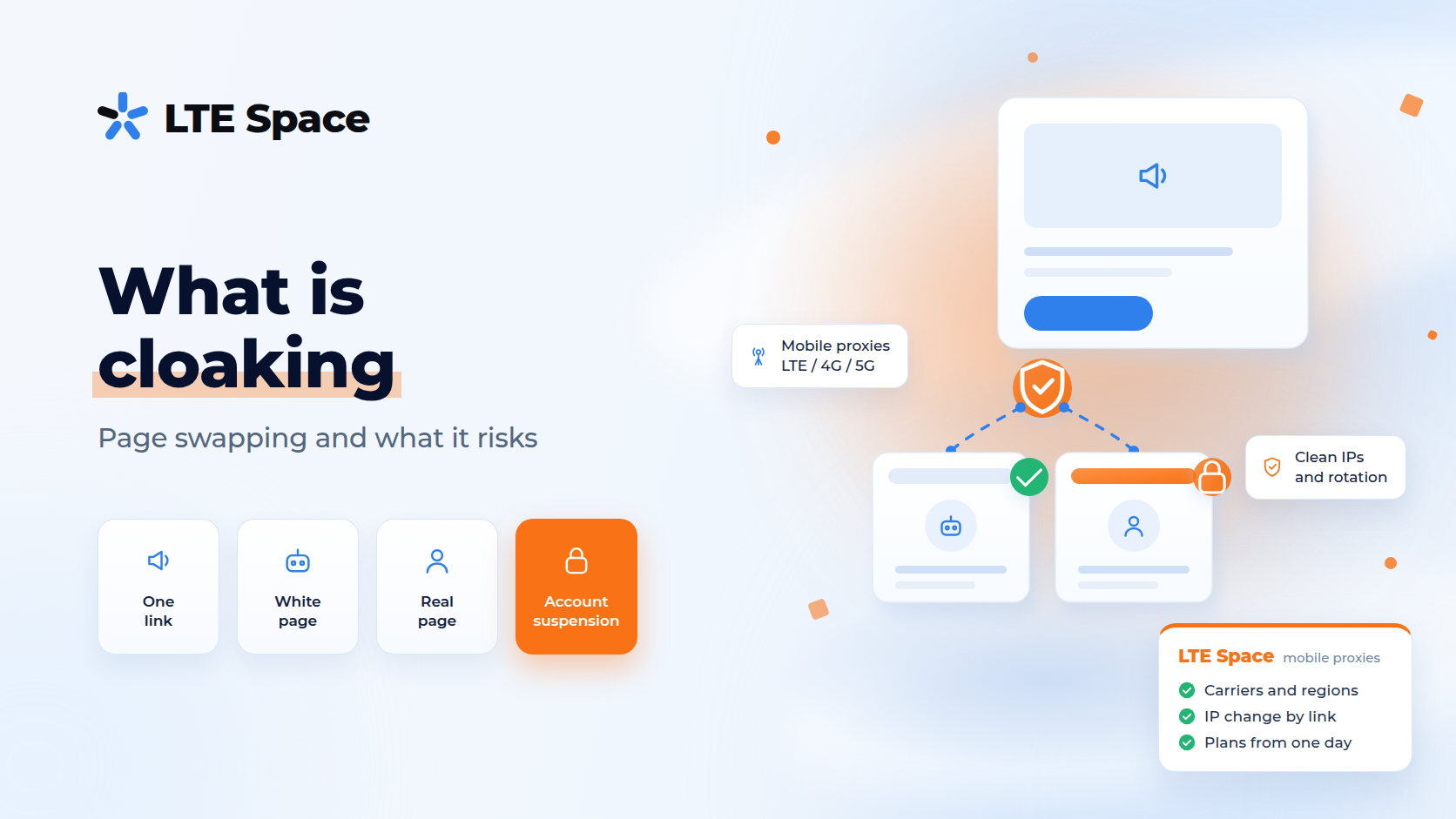
Cloaking is page swapping: the same link shows a reviewer one page and a regular visitor another. The word comes from “cloak” — a cover that hides what is underneath. In 2026 people mostly ask about cloaking in the context of affiliate marketing and media buying, where it is used to hide prohibited offers from ad review. This article explains how the swap works, why every major platform bans it and where showing different content to different people is perfectly legitimate.
What is cloaking in simple terms
A cloaked page has two faces:
- the white page — a harmless site such as a blog, a store or a compliant product page. Moderators, platform bots and anyone the system flags as a reviewer see it;
- the black page — the real target: an offer the platform would never approve. Only visitors who look like targeted customers see it.
The visitor doesn’t know the second page exists. Neither does the moderator: they review the white page and approve the ad. That is where the name comes from — the real page stays under the cloak.
In affiliate slang the swapping script is called a cloak, and the companies selling it are cloaking services. More terms from the niche are collected in the affiliate marketing glossary.
How cloaking works
Every request to the page first goes through a filter. The filter looks at signs of the visitor and picks which page to return in a fraction of a second. It usually checks:
- the IP address and its owner — whether it belongs to a data center, a known platform network, a VPN, or a home or mobile carrier;
- the country and city behind the IP address;
- the device and browser — the User-Agent string, screen size, system language;
- the referral source — whether the visitor came from an ad or opened the link directly;
- how the page behaves in the browser — whether JavaScript runs and whether there are signs of automation.
If the signs look like a reviewer, the filter returns the white page. If they look like a targeted visitor, it returns the black page. Some systems change the content at the same address; others redirect the visitor to a different domain.
Sites use the same signs to tell people from bots in legitimate tasks too. The details are covered in mobile proxies and antifraud in 2026 and how browser fingerprinting works.
Cloaking in affiliate marketing
In traffic arbitrage cloaking is used for two reasons:
- to get through ad review with an offer the platform bans or restricts: questionable supplements, gambling, financial schemes;
- to hide the working landing page from competitors and spy tools that collect other people’s campaigns and copy them.
The first reason is a direct policy violation. The second looks more innocent, but a platform can’t technically tell them apart: all it sees is that the reviewer got a different page from real users. That is why the rules ban cloaking as a whole, not only for prohibited products.
Cloaking in SEO
Cloaking exists in search optimization too. The search crawler gets a page stuffed with target keywords, while visitors get something else. Google’s spam policies define cloaking as presenting different content to users and search engines with the intent to manipulate rankings and mislead users. Their example: a travel page for the search engine and a discount drugs page for visitors.
A site caught doing this loses rankings or drops out of search results. Legitimate ways to work with search are covered in mobile proxies for Google SEO.
What cloaking risks
The risks are higher than the ads for cloaking services suggest:
- suspension without warning. Under Google Ads rules cloaking falls under the circumventing systems policy and counts as an egregious violation. Accounts are suspended upon detection, without prior warning, and the advertiser can’t run Google Ads again;
- related accounts. According to Google, accounts related to a suspended one may be suspended as well, and so may new accounts the advertiser tries to create. Meta also prohibits tactics that circumvent ad review, and cloaking is one of them;
- lost budget. Money left on a suspended account is hard or impossible to get back;
- domain blacklists. A domain caught serving a swapped page stops passing review in new accounts too;
- legal liability. Cloaking itself breaks platform rules. If it hides misleading ads or a prohibited product, the advertiser answers to more than the platform.
A cloaking filter is never perfect. Platforms keep changing how they check, and a single miss exposes the swap.
When different content is not cloaking
Showing different things to different people is fine as long as a reviewer under the same conditions sees what a visitor sees. These are not cloaking:
- geo-targeting — different prices, languages or catalogs per country, as long as a reviewer from that country sees what a buyer sees;
- a mobile version — a different layout for phones with the same content;
- A/B testing — two versions of a page for part of the audience, as long as both comply with the rules;
- paywalls — Google doesn’t treat them as cloaking if it can see the full content, just like a subscriber can;
- bot protection — a CAPTCHA or blocking harmful bots, as long as people and reviewers get the same page.
The line is simple: page swapping becomes cloaking when a site singles out reviewers and hides the real page from them.
How platforms and advertisers catch cloaking
Platforms don’t rely on a single moderator. They open an ad again from different addresses and devices, including home and mobile IP addresses, and compare what they get. If a page changes depending on who is looking, it shows.
Advertisers and agencies use the same method. They check where and how their ads appear, whether partners swapped the landing page, and whether an ad leads to someone else’s site. This is called ad verification. It needs the view of a regular visitor from the right region, so it is done through mobile and residential proxies. The process is described in ad verification proxies.
Mobile proxies and cloaking
A mobile proxy changes the address of whoever sends the request: the site sees a carrier IP address instead of a data center one. The proxy doesn’t change the page the site returns and doesn’t hide a swap from review. It won’t prevent a cloaking suspension either: the platform bans the account for what the site showed, not for the address the advertiser worked from.
Mobile proxies are useful here in a different way. Through them you can open an ad and its landing page the way a regular subscriber in a given country sees them, and compare that with what an office check sees. That is how an advertiser catches a swap by partners and how a site owner confirms the page is the same for everyone. LTESpace plans with carrier addresses in different countries work for this kind of check.
Summary
Cloaking is page swapping in which a reviewer sees a harmless site and a visitor sees a different offer. It is used in affiliate marketing and SEO, and every major platform bans it: Google Ads suspends accounts without warning and for good. Showing different content to different people is fine as long as a reviewer under the same conditions sees what a visitor sees.