
 English
 Русский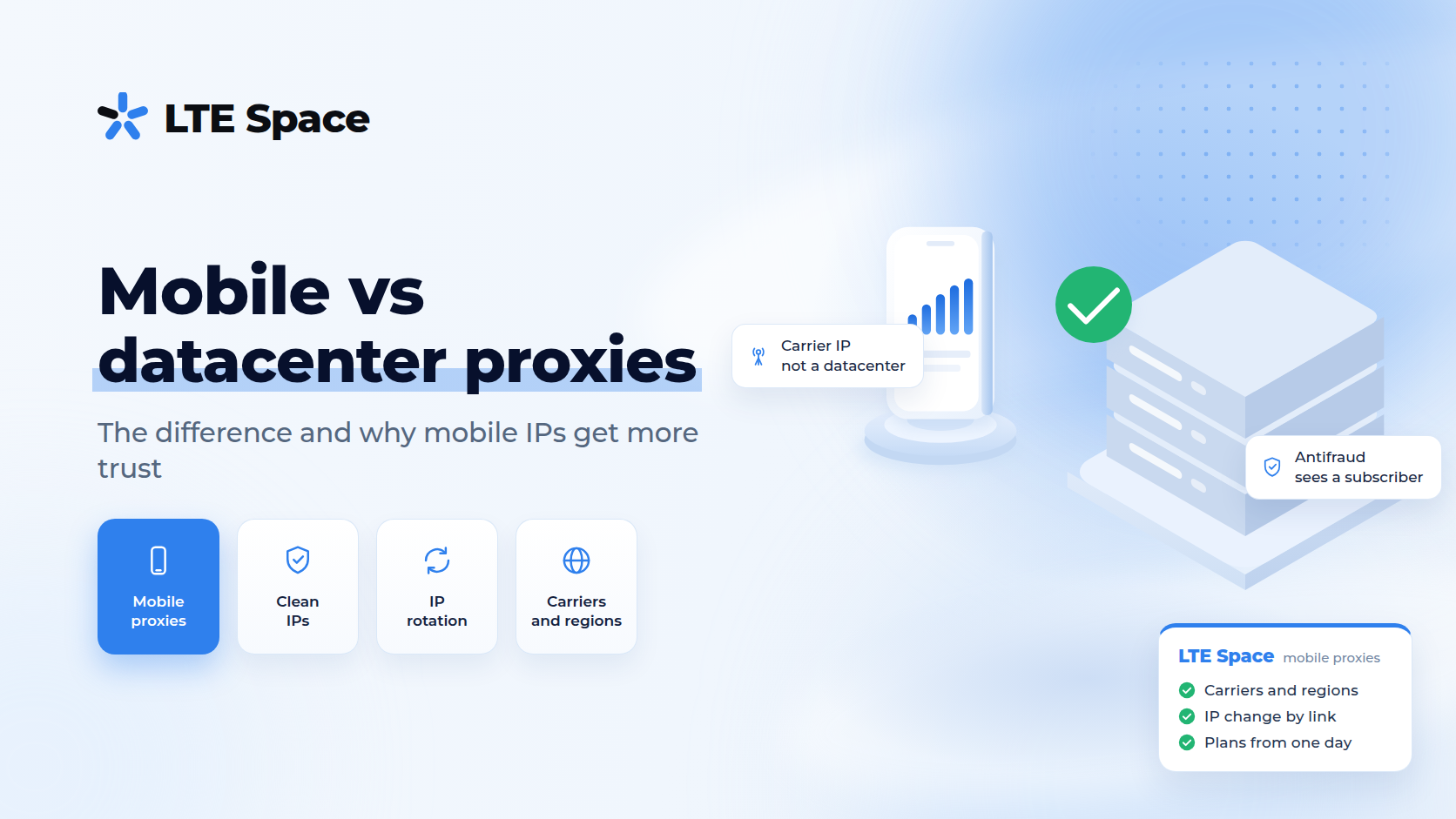
Mobile proxies connect to the internet through a mobile carrier’s network: a website sees an IP address that belongs to the carrier, just like an ordinary subscriber with a smartphone. Datacenter proxies run on servers in data centers, and their addresses belong to hosting companies. Both types can “change the IP”, but platforms treat them differently, and in 2026 that decides whether a registration, an ad campaign or a scraping job goes through.
Where the IP address comes from
The key difference is who owns the address. Any website can tell from an IP which network it belongs to.
- A datacenter proxy uses an address from a hosting provider’s range. These ranges are publicly known, and IP databases label them as datacenter. Ordinary people do not browse from a data center, so the platform knows at once that it is dealing with a server.
- A mobile proxy uses a carrier’s address. Ordinary subscribers go online through the same address at the same moment: carriers give one public IP to many devices, a technology explained in CGNAT in mobile proxies.
Platform trust
The origin of the address leads to a different attitude towards it.
A datacenter address is easy to block: there are no real people behind it, and a whole subnet can be closed with it. Social networks, ad accounts and services with sign-up therefore show more captchas, ask for verification or restrict actions from such addresses straight away.
A mobile address is expensive to block: together with it the platform would cut off the carrier’s real subscribers. Mobile IPs are handled with more care, and the platform judges the account’s behaviour rather than the address itself. The mechanism is explained in why mobile proxies outperform datacenter proxies.
Speed and stability
Here datacenter proxies win. A server sits in a data center with a wide channel, its latency is minimal and its speed is predictable.
A mobile proxy depends on the cellular network: the speed is lower, latency is higher and varies during the day. For accounts, ads and checking search results this is more than enough, but for downloading large volumes of data a datacenter channel is faster and cheaper.
IP rotation
A datacenter proxy usually has a fixed address. Another address means another proxy, so large tasks need batches of addresses.
A mobile proxy changes its address within the carrier’s pool, on a timer or on request. More in mobile proxies with rotation. At LTESpace a shared channel changes the address on its own, on a timer, while a private channel changes it by a special link.
Price
Datacenter proxies are cheaper: one server holds many addresses. A mobile channel needs a modem, a SIM card and mobile traffic, so it costs more. Compare the cost of the result, not the cost of one address: a cheap address that the platform blocks at the door ends up more expensive.
When datacenter proxies are enough
- scraping open data on sites without serious protection;
- monitoring website availability and speed;
- downloading large volumes of data;
- tasks where the platform does not care who is asking.
When mobile proxies are needed
- registering and running accounts on social networks and marketplaces;
- ad accounts and media buying;
- checking ads and search results the way a mobile user sees them;
- scraping sites that block data centers with captchas or bans;
- working from a specific country where matching a local carrier matters — see mobile proxy geography.
The protocol does not depend on the proxy type: both datacenter and mobile proxies work over HTTP(S) and SOCKS5. How to choose a protocol for a program is covered in HTTP, HTTPS and SOCKS proxies: the difference.
Summary
Mobile and datacenter proxies differ in who owns the address, and everything else follows from that: platform trust, rotation and price. Datacenter proxies are faster and cheaper and suit open data and large volumes. Mobile proxies are needed where the platform checks who has come: accounts, advertising, protected sites. Mobile channels for such tasks are in the LTESpace plans.