
 English
 Русский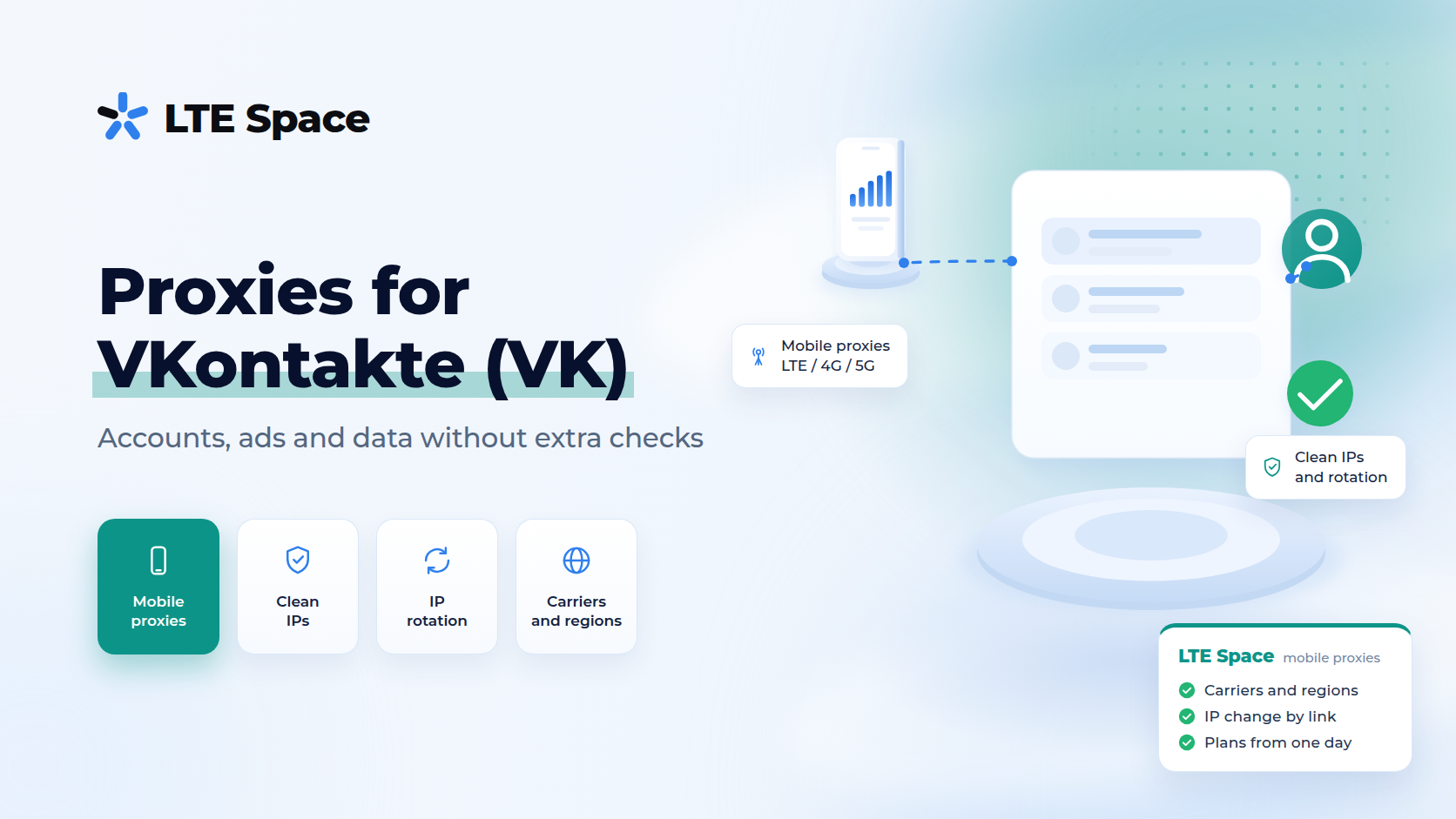
Proxies for VKontakte are separate IP addresses that SMM specialists, agencies and marketers use to work with VK accounts and communities: to run client pages apart, check ads in different cities and collect public data. VK, the largest social network in Russia, watches logins closely: a new address, an unfamiliar region or a dozen accounts behind one IP lead to SMS confirmation, captchas or a temporary freeze. A VK proxy makes each account look like a separate user with its own steady address.
What proxies are used for on VK
- client accounts — an agency or freelancer running pages and communities of different clients from one computer keeps each account on its own address, so VK does not link them;
- ad checks — VK Ads are targeted by city and interests. To see your own and competitors’ ads the way a resident of another city does, you need an address there; more in ad verification proxies;
- public data collection — community members, posts and competitor activity for analytics;
- working from abroad — VK asks for confirmation more often when a Russian account logs in from another country. A Russian mobile address removes that signal; where a network or country restricts access to the site, local laws still apply.
How VK reacts to suspicious logins
- a login from a new IP and a new device — an SMS code request;
- many accounts behind one address — captchas and checks, then restrictions;
- a datacenter IP instead of an ordinary provider — more confirmations;
- a sudden change of region within one session — looks like a hijack and may lead to a freeze until access is restored.
Hence the simple rules: one account, one address; the address is Russian and steady; the region matches where the account usually works from.
Which proxies to choose for VK
Free proxies do not fit: their addresses are long blacklisted, and the server owner sees the traffic passing through, logins included. More in where free proxies come from.
Datacenter proxies are recognised by VK from the datacenter network, and such logins are sent for checks more often.
Mobile proxies from Russian carriers look like an ordinary subscriber with a smartphone. For VK accounts this is the calmest option.
Which channel for which task
- a private channel — for accounts: assigned to one user, the address changes only on your command, by a special link;
- a shared channel — for collecting public data: the address changes on its own, on a timer;
- multiregion — exits through different regions of Russia with an address change every 2 minutes: for data collection and checks that need coverage of many regions rather than one particular city.
What not to do
Mass following, liking and commenting break VK’s rules, and a new IP does not save an account from a ban for them. For scheduled posting VK has built-in delayed posts, and for analytics there is the official API — start with those.
How to connect a proxy
Set the proxy in an anti-detect browser profile or in the settings of an ordinary browser:
- set up mobile proxies in Google Chrome;
- set up mobile proxies in Firefox;
- mobile proxies in Dolphin Anty — for several accounts.
Summary
Proxies for VKontakte let you run client accounts separately, check ads by city and log in to a Russian account calmly from abroad. Steady Russian mobile addresses work best — one per account. Channels for these tasks are in the LTESpace plans.