
 English
 Русский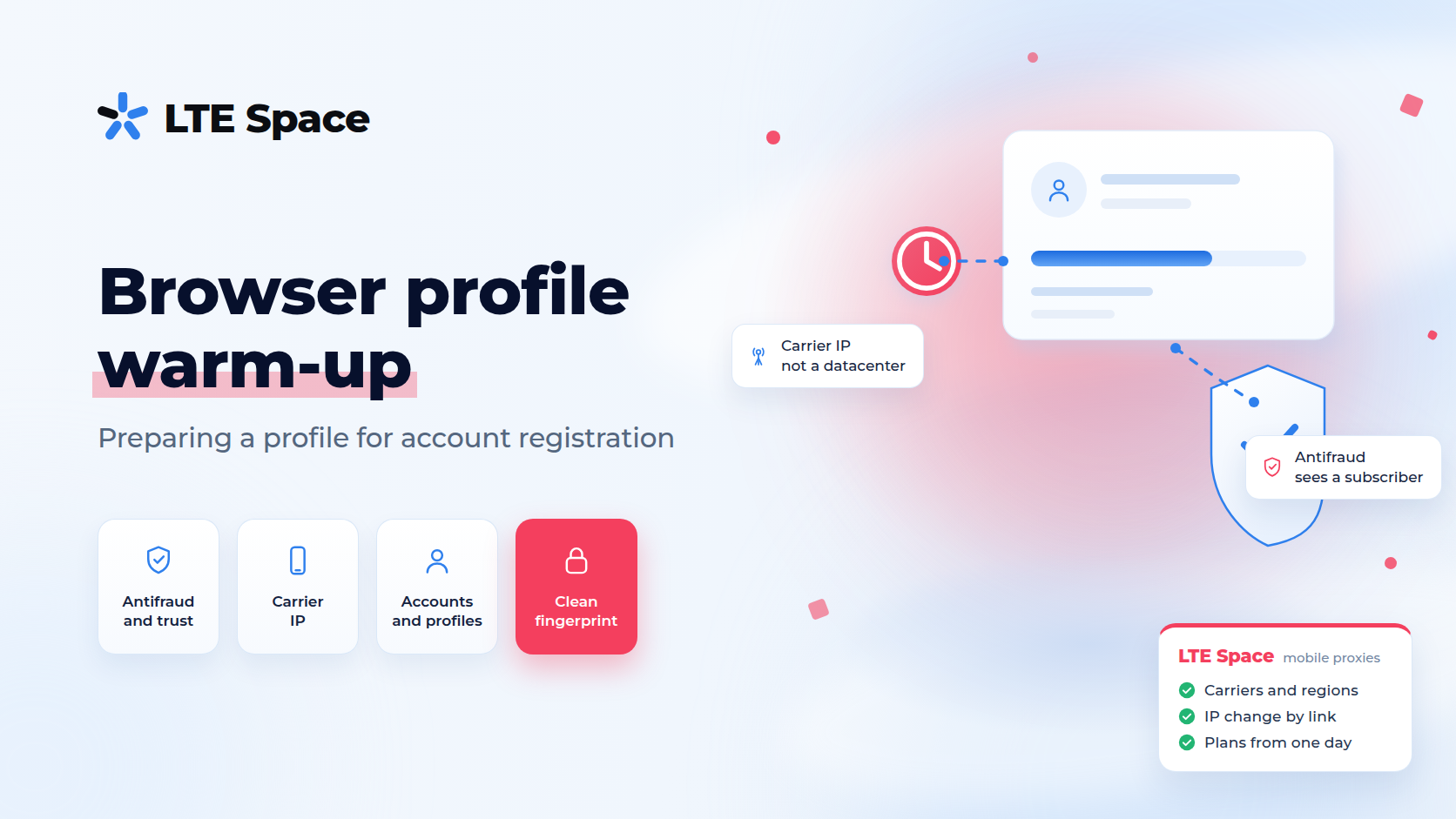
Browser profile warm-up for account registration is the technical preparation of the environment before working with new accounts, one by one or in series. In 2026 a mobile IP alone is no longer enough: anti-fraud analyses not only the network but also the browser fingerprint, the history of actions and whether the time zone, language, WebGL, Canvas, fonts and behaviour agree with each other.
Why warm-up is needed
Most bans do not happen when the SMS code is entered but in the first minutes after the account is created. The platform sees a new account, a new fingerprint, an empty history and often an unnaturally “clean” session. Add a sudden login from a doubtful IP, the same User-Agent on dozens of profiles or repeated actions, and the registration is rated as high-risk.
That is why warm-up is not a formality. It lowers the number of technical anomalies in the first sessions. Anti-fraud wants the profile to look like a real user environment: predictable behaviour, a correct locale, working cookies, consistent network logic and a natural session length.
In practice three overlaps create the highest risk: a shared fingerprint, a repeated scenario of actions and an unstable network. When a farm of accounts does not separate these, bans come in batches rather than one at a time.
It is worth understanding in advance how account registration with mobile proxies changes the trust model and why even a good profile gives no stable result without a consistent network.
The four layers of a warm-up
The network layer. Mobile IP, ASN, country, time zone and DNS behaviour. The profile must open from the geography that fits the task. If an account is created for the USA while the browser shows a Russian locale, a European time zone and a mobile IP of a third country, anti-fraud receives conflicting signals. Proxies are chosen not only by availability but by how well they match the language, region and type of traffic.
The fingerprint layer. The anti-detect browser builds a unique browser fingerprint: Canvas, WebGL, fonts, hardware parameters, media devices, screen resolution, platform and User-Agent. A common mistake is to make the fingerprint unique but not plausible. A rare screen resolution, an unusual pairing of graphics card and operating system or a suspiciously “perfect” set of parameters raise the risk on their own.
The user data layer. A warmed-up profile has at least a minimal history: cookies, local storage, a few visited sites, open pages, search visits, time between actions, secondary events within the session. An empty profile that goes only to the sign-up page looks weaker than an environment with a short but logical past.
The behaviour layer. Good mobile proxies and a correct anti-detect browser do not make up for scripted behaviour. Typing speed, identical intervals, the same scroll depth, the same route through the site, leaving right after registration — all of these are anti-fraud signals. A warm-up needs controlled variety of scenarios.
The reputation of the address matters here too: the IP trust score shapes the first assessment of a new session before the first registration step is finished.
Warm-up in practice: three phases
Phase 1. Preparing the profile. A separate profile is created in the anti-detect browser, with a fixed:
- interface language;
- time zone;
- geolocation;
- User-Agent;
- WebRTC policy — see how to disable WebRTC;
- DNS behaviour;
- mobile IP of the chosen country.
The profile does not register an account straight away. It runs a few short sessions first: opens a search engine, visits neutral sites, works with tabs, sometimes returns to the same domain. The goal is not to imitate a “real person” in the abstract but to make the environment less empty. The time zone must match the IP — details in mobile proxies and time zone in anti-fraud.
Phase 2. Soft registration. Registration should not be the first contact with the domain. Between opening the site and submitting the form there is a short logical chain: a few pages, the help section, the login page, a pause, a step back, and only then sign-up. For SMS verification timing is critical: long empty waits between requesting the code, entering the number and confirming make the session look broken. How network, behaviour and browser signals interact is covered in mobile proxies and anti-fraud in 2026.
Phase 3. Post-registration warm-up. Many setups stop right after the account is created. To anti-fraud that looks unnatural. After registration the profile performs two to four safe actions: confirms the email, fills in part of the profile, opens sections of the interface, pauses, comes back to the session later. This is when the first pattern of trust is set.
Warm-up at scale
With single registrations mistakes often go unnoticed. At volume they become a systematic problem. If a farm of accounts uses one set of templates, anti-fraud quickly links the profiles by cluster features.
At volume, warm-up requires spreading profiles in five directions:
- different fingerprint templates;
- different sources of mobile IPs;
- different first-session scenarios;
- different activity windows;
- different post-registration routes.
Scaling is limited not by the number of profiles but by how well they are isolated. A hundred profiles built on one template are not a farm but one repeated technical object.
Multiport mobile proxies help spread the load across ports and avoid concentrating many registrations on one network path. Geography matters as well: local services expect the country, city, language and time zone to match; international platforms allow a wider range, but a conflict between locale and IP remains a negative signal. See mobile proxy geography.
Summary
Browser profile warm-up for account registration is not an optional extra but a required part of the technical setup. Anti-fraud rates a profile as a whole: mobile proxies, the anti-detect browser, the session history, behaviour, geography and the consistency of the environment. If one layer falls out of the common logic, the risk of a ban grows.
A profile is warmed up from one address, so it needs a private channel with IP change by link — such mobile proxies are available in the LTESpace plans.