
 English
 Русский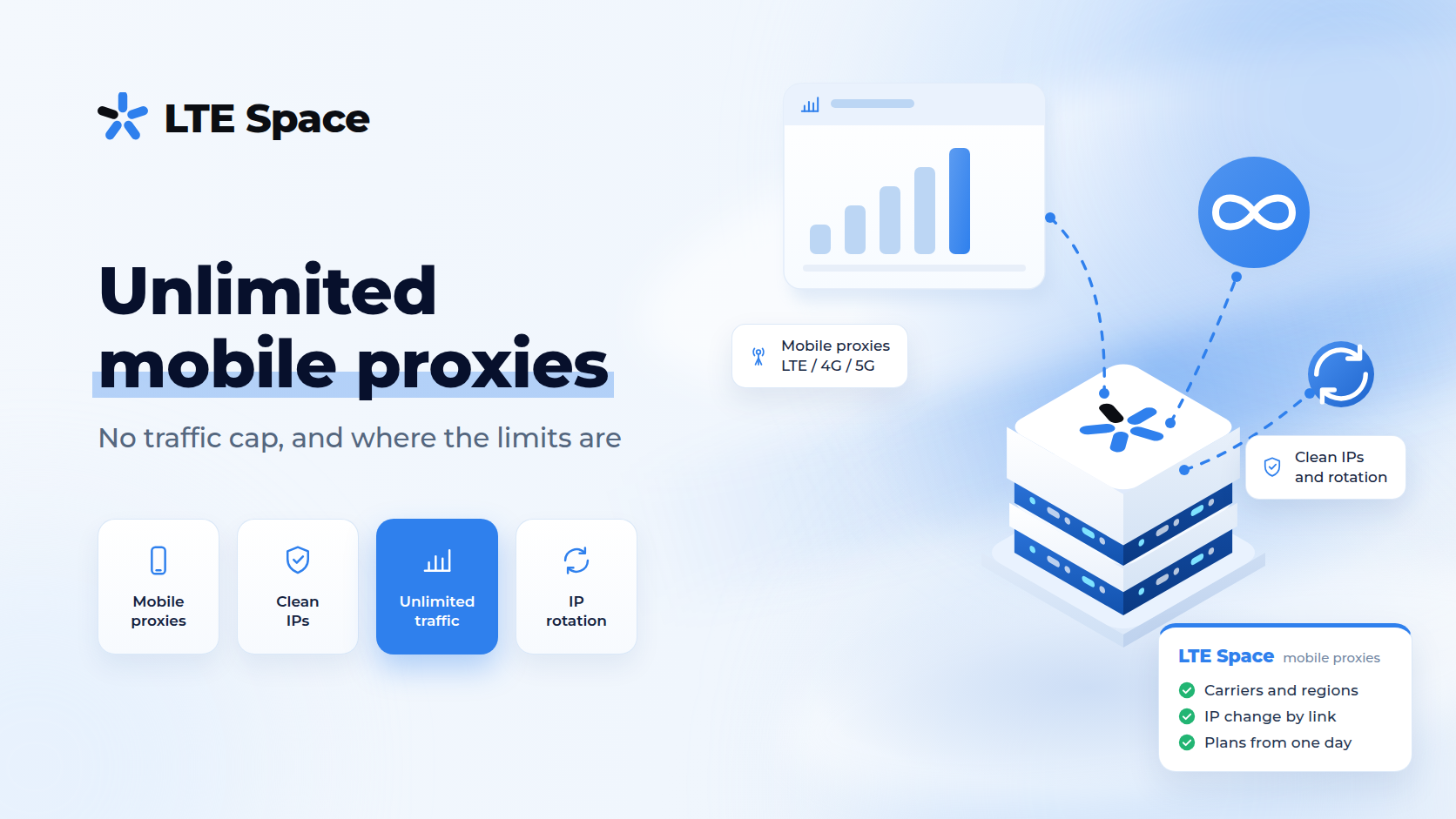
Unlimited mobile proxies are channels whose traffic volume is not counted: you pay for the rental period, not for gigabytes. However many pages, images and videos pass through the channel in a month, the price stays the same, and the traffic does not run out in the middle of a task. In 2026 this matters most for web scraping, round-the-clock automation and browser profiles, where heavy pages eat through gigabytes faster than you expect.
How proxies are sold: per gigabyte or per period
There are two pricing models on the market:
- per traffic: each gigabyte is paid for separately, and the package ends once the volume is used up. Residential proxies are usually sold this way;
- per channel and period: a fixed price for a day, a week or a month, with no gigabyte count. Mobile proxies backed by a dedicated modem with a SIM card are usually sold this way.
Paying per gigabyte looks cheaper at first, but it is hard to predict. A marketplace page with images weighs many times more than its HTML, video and social media feeds weigh even more, and software updates or background browser requests use traffic without the user noticing. When you pay for a period, none of this shows up on the bill.
What “unlimited” means at LTESpace
Every LTESpace plan comes with unlimited traffic: shared channels, private channels and Multiport alike. Monthly prices for Russia:
- Shared: ~$8;
- Multiport: ~$8 per thread;
- Multiregion: ~$11;
- Shared without waiting: ~$16;
- Private: ~$39.
The minimum term is one day: a shared channel costs ~$1.6 a day and a private one ~$8. How the daily price changes when you rent for a week, a month or three months is covered in mobile proxy rental.
Where unlimited ends
Unlimited traffic does not mean that nothing is limited. The limits lie elsewhere, and it is worth knowing them before you buy.
Speed. The channel runs through a modem on a cellular network, so its speed depends on how busy the carrier’s network is at the moment. It is ordinary mobile internet, not a datacenter line, and unlimited volume does not make it any faster.
Customers per channel. A shared channel serves up to 5 customers (up to 7 in Georgia), and they split the modem’s bandwidth between them. A private channel belongs to one customer and gives the highest speed.
Simultaneous connections. In Russia a shared channel allows up to 100 connections, Shared without waiting up to 150 and Multiregion up to 65. In other countries the shared plan allows up to 100 connections. A private channel has no connection limit, and Multiport allows as many connections as the threads you bought, up to 50.
IP change. When the channel changes its IP, open connections drop. On a shared channel the port waits up to 5 seconds for the new address; on the “without waiting” plans the new address is issued at once.
Who needs unlimited traffic most
- large-scale scraping, especially when pages load in full with images and scripts, see proxies for web scraping;
- round-the-clock automation: bots and scripts that run without breaks, see mobile proxies for bots;
- browser profiles and antidetect browsers: social feeds, ad accounts and video load a lot of data even with manual work;
- ad and search result checks: every check loads a full page with banners;
- website and app testing: downloading and updating heavy files through the right country.
When paying per gigabyte is cheaper
If a task fits into a few light API calls a day and does not repeat, a gigabyte package may cost less than a monthly channel. Yet unlimited channels have a daily plan for one-off tasks too: for ~$1.6 you can push as much data through a shared channel as it carries in a day without counting megabytes. Before renting, take the free 2-hour test, which support issues after you sign up.
Unlimited proxies with rotation
Unlimited traffic and rotation do not exclude each other: every LTESpace plan is dynamic, and the address changes with no traffic cap. The Shared channel changes its IP every 2 or 5 minutes, Shared without waiting and Multiregion every 2 minutes, Private by link, by API or on a timer from 1 to 60 minutes, and Multiport with every new connection. How to choose the way the address changes for your task is explained in the mobile proxies with rotation guide, and how a dynamic address differs from a fixed one in dynamic mobile proxies.
How to choose an unlimited plan
- one or two browser sessions, social media, ad accounts: a private channel, with a stable address and the modem’s full speed for you alone;
- scraping in dozens of threads: Multiport, with a new IP for every connection and as many threads as the program needs;
- collecting data without being tied to one city: Multiregion;
- one-off checks and small tasks: a shared channel, or Shared without waiting when the address changes often and pauses get in the way.
You can compare plans and see the price for the term you need in LTESpace pricing.
Summary
Unlimited mobile proxies are paid for by period, not by gigabyte, so the volume of traffic affects neither the price nor whether a task runs to the end. At LTESpace traffic is unlimited on every plan and every term, from one day to three months. What is limited is something else: the speed of the cellular network, the number of customers on a shared channel and the number of simultaneous connections, and those are what a plan should be chosen by.