
 English
 Русский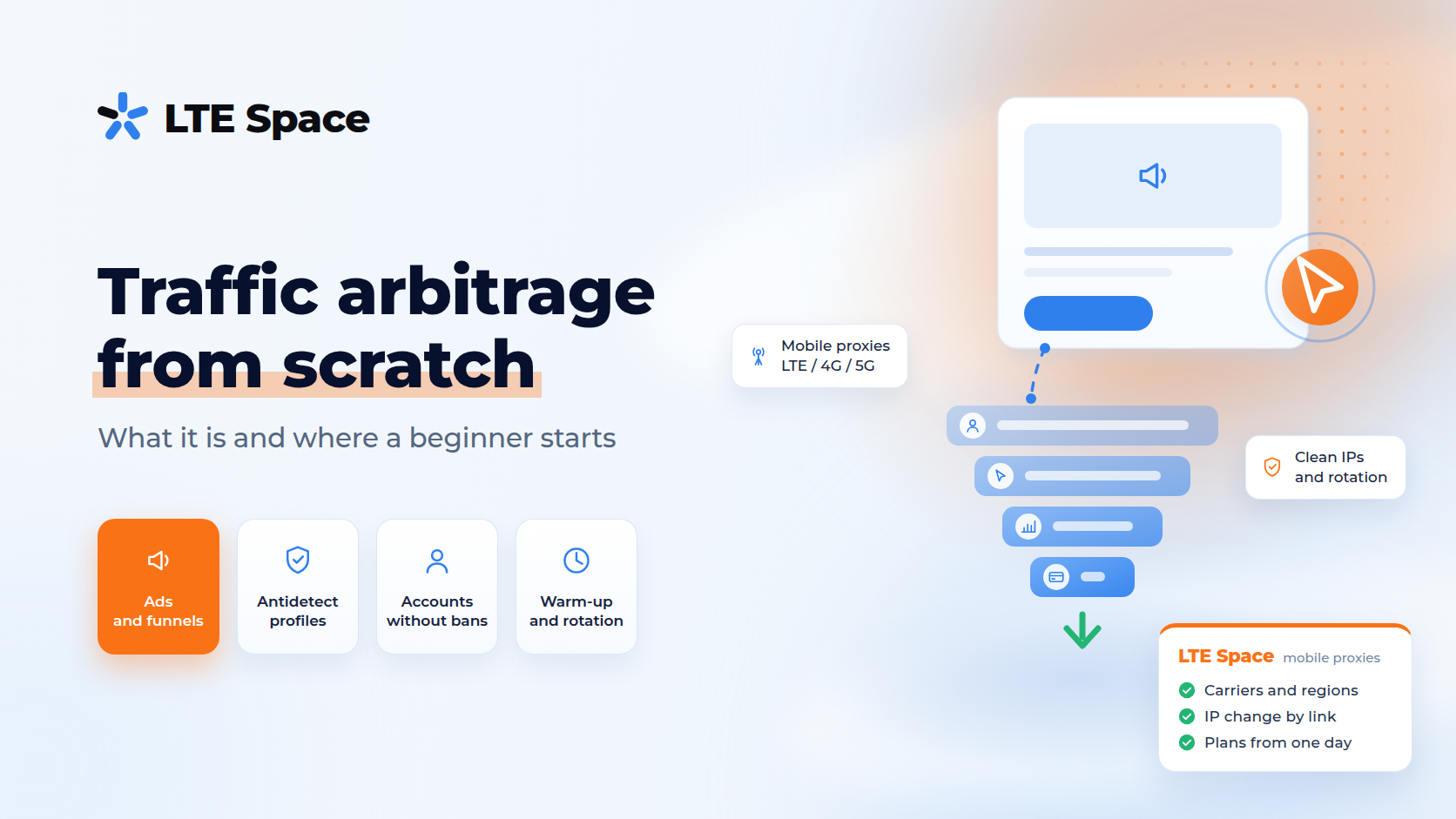
Traffic arbitrage is earning on the gap between the cost of advertising and the advertiser’s payout: a media buyer purchases impressions or clicks in an ad network, sends users to the advertiser’s offer and is paid for every target action — a lead, a sign-up, a purchase. If the ads cost less than the payouts they brought, the difference is profit. In 2026 the field is still open to newcomers with a small budget, but it demands discipline: ad platforms check accounts more strictly, and infrastructure mistakes cost money.
Who takes part in traffic arbitrage
- the advertiser — a company that sells a product or service and pays for results;
- the affiliate network — the middleman: it collects advertisers’ offers, issues tracking links, counts actions and pays out;
- the media buyer — buys ads, prepares creatives and landing pages and is responsible for the traffic paying off;
- the traffic source — an ad network or platform where impressions are bought: social networks, search ads, native and push networks;
- the user — a person who saw the ad and took the action.
Industry terms are explained in the affiliate marketing glossary.
How media buyers get paid
- CPA — a fixed payout per action: a lead, an app install, a sign-up;
- CPL — a type of CPA, paid per contact of a potential customer;
- CPS — a percentage or fixed amount per sale;
- RevShare — a share of the revenue the advertiser earns from the referred customer, often for life.
Results are measured with ROI: (payouts − spend) / spend × 100%. Spend 100 dollars on ads, earn 140 — ROI is 40%. Negative ROI during tests is normal: it is the price of finding a combination that works.
How to start traffic arbitrage from scratch
- Learn the basics. Terms, payout models, ad platform rules. Each platform’s moderation decides which offers can be advertised there at all.
- Pick a traffic source. A beginner does better mastering one source than spreading across several.
- Pick an affiliate network and an offer. Look at the payout, traffic requirements, allowed countries and how fairly leads get approved.
- Set a test budget. The first campaigns collect data rather than profit. Money you cannot afford to lose does not go into arbitrage.
- Install a tracker. Without counting clicks and conversions per ad, there is no telling what works.
- Study competitors. Spy tools show which ads run for a long time and are probably profitable.
- Scale what pays off. Raise budgets gradually and keep spare accounts ready.
A media buyer’s infrastructure
The work happens in ad accounts, and platforms check who logs in. You need:
- a separate anti-detect browser profile for each ad account;
- a separate IP for each ad account, matching the account’s country. A carrier’s mobile address raises fewer questions than a datacenter one — more in proxies for target marketers;
- a calm start for new accounts without sudden launches — IP warm-up before launching ads;
- separate payment cards per project.
Risks
- ad account bans — the biggest cost after the ad spend itself;
- “grey” offers that fail platform moderation — rules get broken, and accounts are lost faster;
- offers that break the law — not worth any money, simply not taken;
- delayed payouts and rejected leads at dishonest affiliate networks.
Summary
Traffic arbitrage means buying ads and earning on advertiser payouts for user actions. Starting from scratch works best with one traffic source, one affiliate network, a tracker and a test budget. Separate profiles, a separate IP for every ad account and a careful start keep the work stable. Mobile channels for ad accounts are in the LTESpace plans.