

 English
 Русский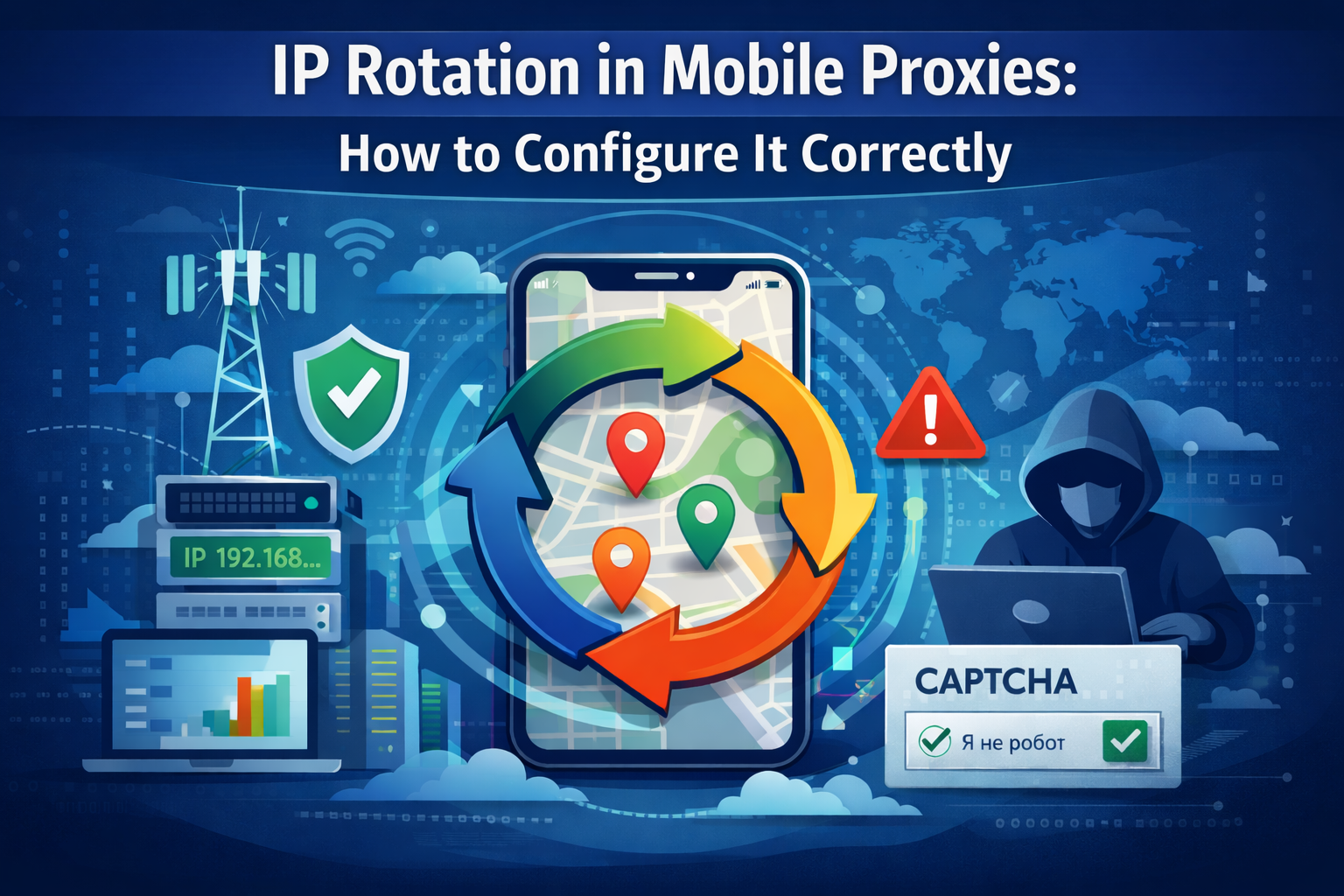
IP rotation is one of the key reasons why mobile proxies are considered reliable and trusted by websites. When configured correctly, IP rotation helps reduce block rates, maintain account stability, and mimic real user behavior. When configured incorrectly, it can do the opposite.
In this article, we explain how IP rotation works in mobile proxies, why it matters, and how to use it safely for automation, scraping, and account-based workflows.
What IP Rotation Is and How It Works
IP rotation is the process of changing the outgoing IP address during proxy usage. In mobile networks, this happens naturally due to how carriers distribute traffic between devices.
Mobile proxies benefit from this behavior because:
- multiple users share the same IP ranges;
- IP addresses change dynamically;
- traffic patterns look organic to websites.
This natural rotation is one of the main reasons why mobile proxies are widely used — a concept explained in detail in mobile proxies as an effective solution for arbitrage, SMM, scraping, and more.
Why IP Rotation Is Important for Website Trust
Websites analyze not only the IP address itself, but also how it behaves over time. Static or predictable IP usage is often flagged by anti-fraud systems.
Correct IP rotation helps:
- avoid repetitive request patterns;
- distribute actions across multiple IPs;
- reduce CAPTCHA challenges;
- keep sessions looking natural.
These benefits are the foundation of mobile proxies with rotation features and benefits, where rotation is explained as a core advantage rather than an optional feature.
Common IP Rotation Strategies
There is no single “perfect” rotation strategy — the correct setup depends on the task.
Session-based rotation
- One IP per account or session
- Best for social media and ad accounts
Time-based rotation
- IP changes every X minutes
- Suitable for scraping and monitoring
Manual or on-demand rotation
- IP changes triggered by the user
- Useful for testing and sensitive operations
Choosing the wrong strategy can lead to unnecessary blocks, even when using mobile proxies.
IP Rotation and Proxy Protocols
Rotation efficiency can also depend on the proxy protocol being used. Different protocols handle sessions, authentication, and traffic routing in different ways.
To avoid technical issues and misconfiguration, it’s important to understand the difference between HTTP, HTTPS, and SOCKS proxies, especially when working with automation tools or custom scripts.
Mistakes That Break IP Rotation
Even with mobile proxies, incorrect rotation settings can trigger bans. The most common mistakes include:
- rotating IPs too frequently;
- changing IPs mid-session;
- mixing multiple accounts on one IP;
- ignoring session persistence.
These issues usually appear not because of the proxy itself, but because rotation logic does not match the task.
When IP Rotation Is Especially Important
IP rotation plays a critical role in:
- multi-account management;
- scraping protected websites;
- automation workflows;
- long-running sessions.
For users interested in turning proxy expertise into revenue, rotation knowledge is also useful when promoting services through the affiliate program for selling mobile proxies.
Conclusion
IP rotation is not just a technical feature — it is a trust signal. When configured correctly, rotation allows mobile proxies to behave like real users, reducing detection and improving long-term stability.
Understanding how rotation works, when to apply it, and how to avoid common mistakes is essential for anyone using mobile proxies professionally.


