

 English
 Русский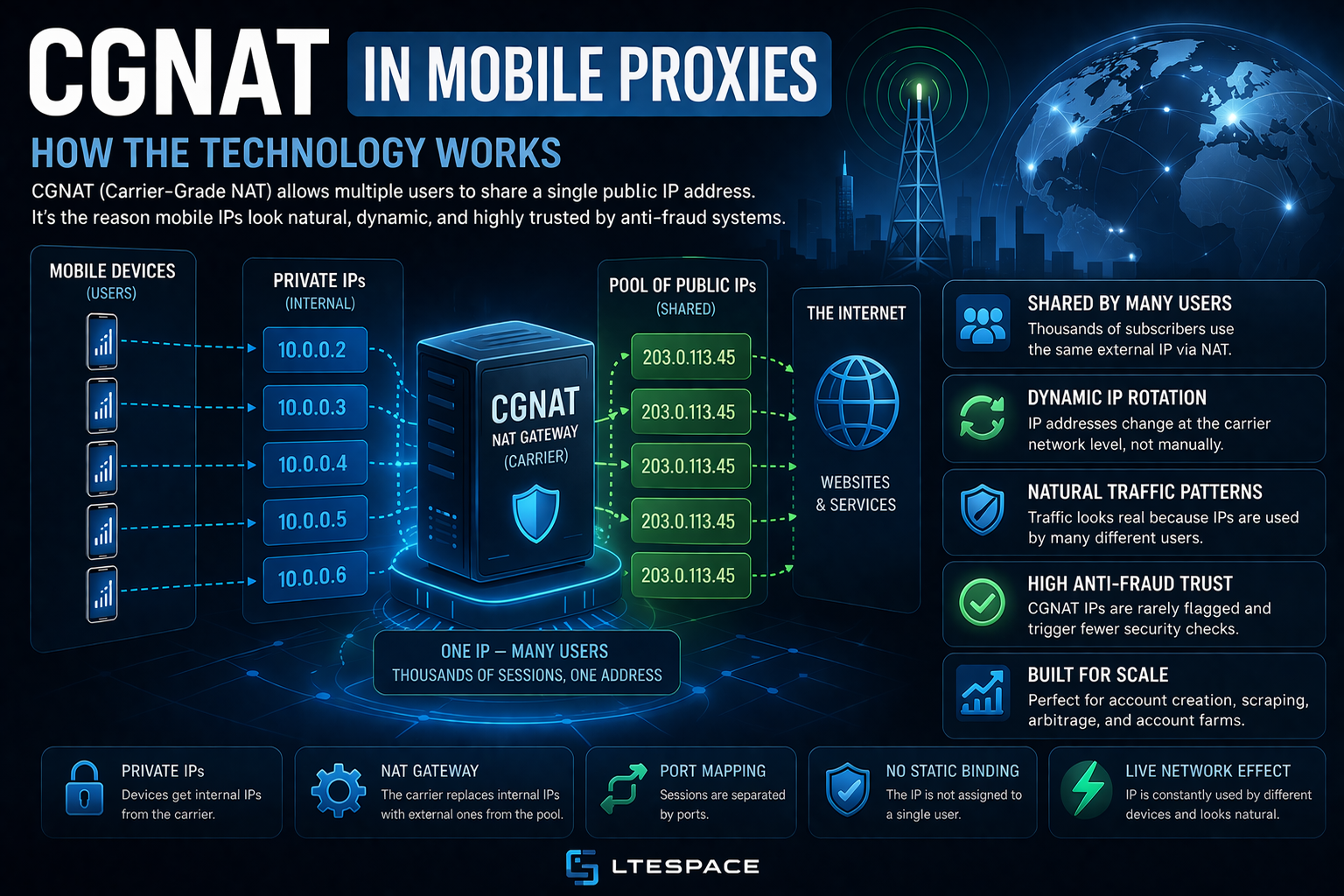
CGNAT in mobile proxies is a network mechanism that allows multiple mobile users to share a single external IP address. In proxy infrastructure, this technology explains why mobile IPs are considered more trusted and how dynamic IP rotation is formed at the carrier level. CGNAT directly impacts session stability, account registration, and performance when working through an anti-detect browser.
Problem: why CGNAT in mobile proxies matters
Mobile carriers do not assign a unique public IP to each device. Instead, they use Carrier-Grade NAT (CGNAT), where thousands of users operate through a shared pool of external IP addresses.
CGNAT in mobile proxies creates a natural traffic pattern because:
- one IP is used by many real users
- behavior behind the IP constantly changes
- there is no strict device binding
- IP rotation occurs at the network level
Unlike datacenter proxies, where an IP is tied to a single client, mobile IPs behind CGNAT look like real consumer traffic. This significantly reduces the risk of restrictions during account creation and platform interaction.
The relationship between mobile IPs and anti-fraud systems is explained in mobile proxies for anti-fraud, where trust is formed at the network level.
Technical breakdown: how CGNAT in mobile proxies works
CGNAT in mobile proxies operates at the carrier infrastructure level. A device receives a private internal IP address, and all outgoing traffic is routed through the operator’s NAT gateway.
The flow is:
- Device → receives a private IP (e.g., 10.x.x.x)
- Traffic → goes to the carrier NAT gateway
- NAT → replaces internal IP with a shared public IP
- Sessions → are separated by ports
This allows thousands of users to share the same public IP simultaneously, while remaining distinguishable via port mapping.
Key characteristics:
- public IP is not tied to a single user
- IP rotation happens naturally
- NAT tables manage connections
- traffic behavior becomes unpredictable
CGNAT in mobile proxies creates a “live traffic” effect, where IP reputation is distributed across many users.
Understanding connection types is also important. See HTTP vs HTTPS vs SOCKS5 in mobile proxies, as protocol choice affects how traffic passes through NAT.
Practical use: where CGNAT in mobile proxies provides advantages
CGNAT in mobile proxies is especially effective in scenarios where traffic authenticity is critical:
- account registration
- account creation
- anti-detect browser usage
- scraping with authorization
- account farming
The key advantage is the lack of static IP binding. Since IPs are shared and constantly reused, the risk of accumulating negative reputation is reduced.
In account registration, this results in:
- lower dependency on a single IP
- higher success rate in anti-fraud checks
- natural network variability
However, CGNAT alone is not enough. It must be combined with proper environment setup, including browser profile warm-up for account registration.
Scaling: how to use CGNAT in mobile proxies correctly
When scaling operations, CGNAT in mobile proxies must be managed as part of infrastructure, not manually.
Key principles:
1. Traffic segmentation
Different tasks should use separate proxy pools.
2. Rotation control
Even though CGNAT provides automatic IP changes, reconnection logic should be managed.
3. Session consistency
Some workflows require stable sessions despite shared IP usage.
4. Multi-port architecture
Allows isolation of traffic flows and prevents cross-contamination.
Using multiport mobile proxies in 2026 enables scalable architecture without losing traffic quality.
Conclusion
CGNAT in mobile proxies is a core mechanism that makes mobile IPs resistant to anti-fraud systems. By distributing traffic across many users, enabling dynamic IP rotation, and removing strict device binding, CGNAT creates a natural network footprint. When configured correctly, it reduces restriction risks, improves account stability, and allows scalable proxy usage.


