
 English
 Русский
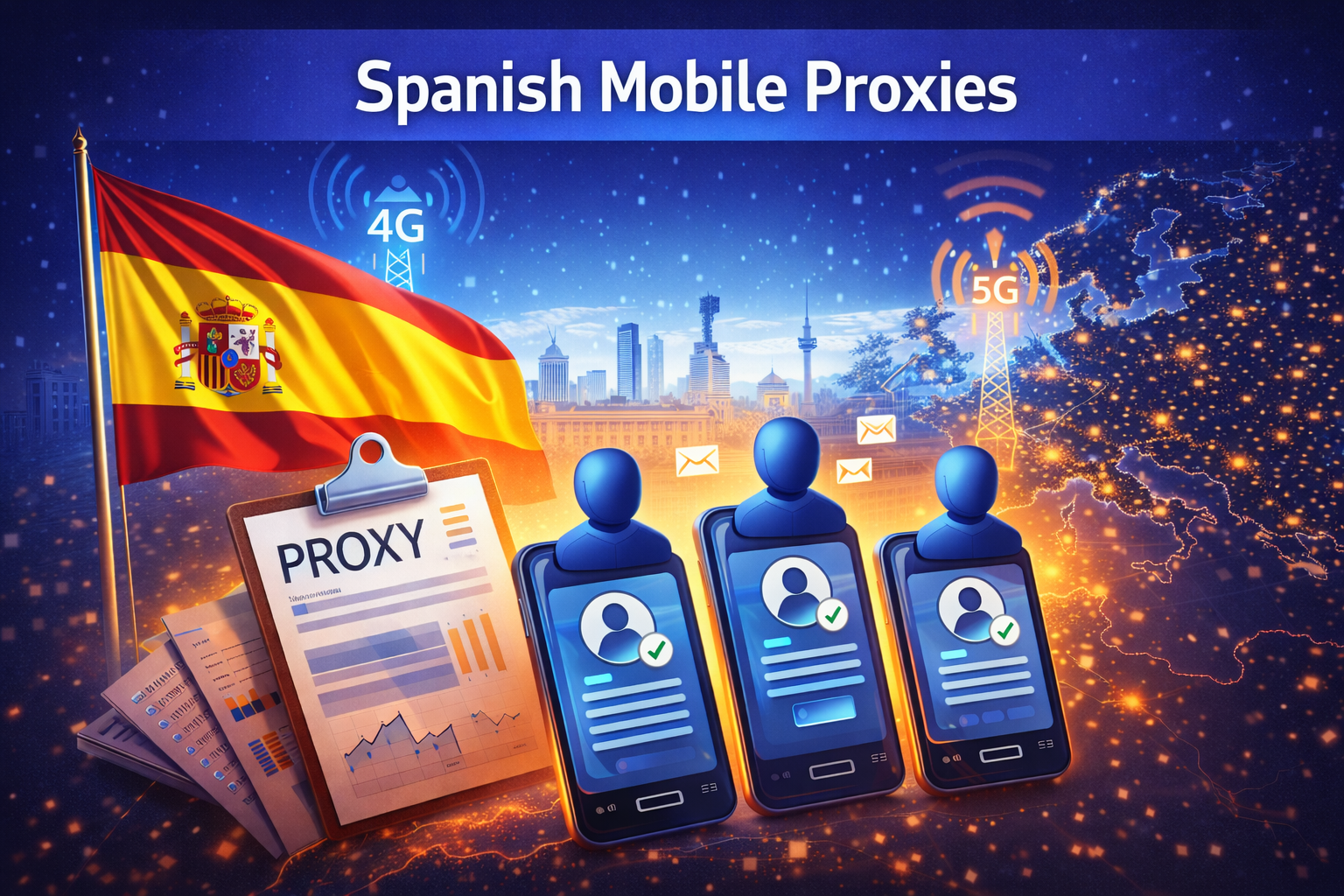
Spanish mobile proxies are connections whose requests reach the internet from the IP address of a Spanish mobile carrier. Spain is the fourth largest economy in the eurozone and a big market for advertising and e-commerce, so a Spanish address is needed where you work with a Spanish audience or with European platforms that adapt to the visitor’s country.
Why Spain is a location of its own
Spain is in the EU, the eurozone and the Schengen Area, but for websites it is a market of its own: the Spanish language, its own Google.es results, its own prices, promotions and ads. A visitor from Spain sees the Spanish versions of marketplaces and services, and neither a French nor a Portuguese address will show them.
The language is a trap of its own. Spanish is also spoken across Latin America, and platforms show Spanish-speaking visitors from Mexico or Argentina entirely different prices and ads. If a task concerns Spain, you need a Spanish address, not just Spanish in the browser. More on the role of the address country in mobile proxy geography.
Where Spanish mobile proxies are used
- ads for Spain: checking impressions, ad copy and landing pages for a Spanish audience;
- marketplaces and classifieds: Amazon.es, Wallapop and Idealista show local prices and offers only to a visitor from Spain;
- search results and SEO: rankings for Spanish queries and Google.es mobile results;
- social media and accounts: profiles whose history is tied to Spain;
- website testing: Spanish localisation, payment in euro, delivery and country restrictions.
A complete Spanish profile
A mobile address is only part of the profile. Spain runs on Central European Time, UTC+1 in winter and UTC+2 in summer, and the system language for a Spanish audience is es-ES, not the Latin American variants. When the address, time zone and language point to one country, the platform sees an ordinary local user. How this is checked is shown in mobile proxies, time zones and antifraud.
Mobile carriers in Spain
Spain’s main mobile networks are Movistar, Vodafone and MasOrange, the merged company of Orange and MásMóvil. Each assigns addresses from its own ranges. A mobile address from any of them belongs to a cellular network, ordinary subscribers use it at the same minute, and blocking it does not pay off for a platform, see mobile and datacenter proxies: the difference.
The order form shows which carrier is available at the moment of ordering: the list depends on free channels and changes.
Spanish mobile proxy plans and prices
- Shared: up to 5 customers per channel, up to 100 simultaneous connections; $2.8 a day, $5.88 a week, $9.8 for 2 weeks, $14 a month, $37.8 for 3 months;
- Private: IP change by link, no connection limit; $14 a day, $29.4 a week, $49 for 2 weeks, $70 a month, $189.1 for 3 months.
Both plans come with unlimited traffic and connect over HTTP or SOCKS5. A shared channel changes its address on a timer; a private one changes it by link or API, or on a timer from 1 to 60 minutes.
Availability changes: when all Spanish channels are taken, the country disappears from the order form. Support can tell you when channels free up.
Spain and neighbouring locations
The nearest location is Portuguese mobile proxies. For other eurozone markets, see France mobile proxies and Slovenia mobile proxies.
When Spain is not the best choice
- for a Latin American audience a Spanish address shows a different market;
- if you need a channel right now and no Spanish ones are free, the closest market substitutes are Portugal and France;
- if the country does not matter, a cheaper location will do.
Summary
Spanish mobile proxies give you an address on a Spanish mobile network and open the Spanish version of platforms, ads and search results, with local prices, the es-ES language and Central European time. A shared channel costs $14 a month, a private one $70, traffic is unlimited, and terms run from one day to three months. Choose a plan in LTESpace pricing.