
 English
 Русский
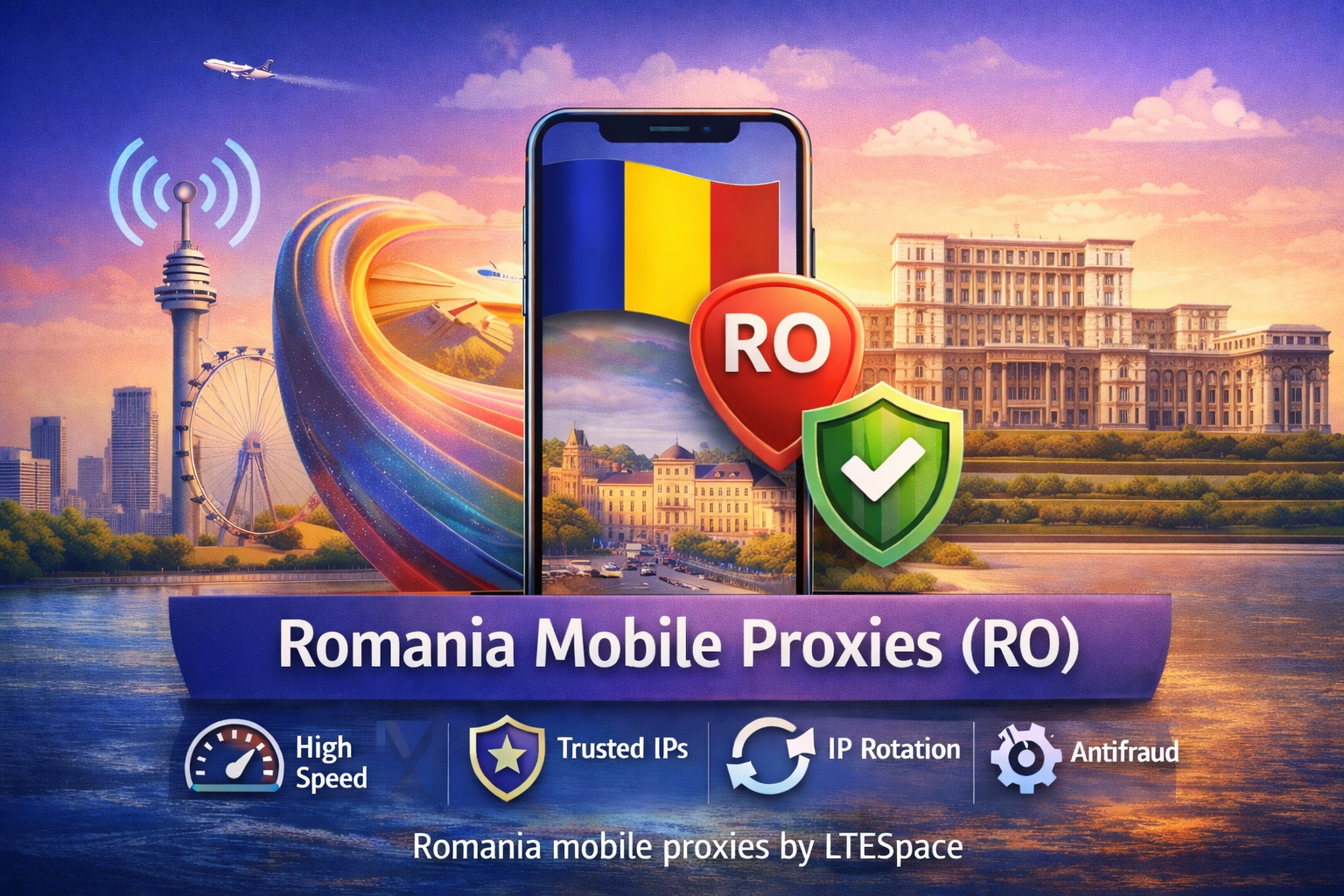
Romania mobile proxies are connections whose requests reach the internet from the IP address of a Romanian mobile carrier. Romania is one of the largest Eastern European countries in the EU, with fast mobile internet and a market of its own, and a Romanian address is needed where you work with the local audience, ads and platforms, or need an affordable European exit point.
Why Romania is a location of its own
Romania is in the European Union and has been a full member of the Schengen Area since 2025, but it pays in its own currency, the leu. For websites it is a separate market: the Romanian language, Google.ro results, local prices and ads. A visitor from Romania sees the Romanian version of platforms, while neighbouring Moldova, with the same language, sees another one with prices in Moldovan lei.
A mobile address adds trust: the IP belongs to a cellular carrier, and ordinary subscribers go online through it at the same minute. So a platform judges the profile’s behaviour rather than the address itself, see mobile proxies and antifraud.
Where Romania mobile proxies are used
- ads for Romania: checking impressions, ad copy and landing pages;
- local platforms: OLX.ro, eMAG and other shops and classifieds show local prices only to a visitor from Romania;
- search results and SEO: rankings for Romanian queries and Google.ro mobile results;
- public data collection: monitoring prices and product ranges in Romanian storefronts;
- automation and testing: checking websites and services with Romanian localisation and payment in lei.
Mobile proxies provide an internet channel only: they cannot receive SMS or make calls, and the channel is meant for the web traffic of programs and browsers.
A Romanian profile
Romania runs on Eastern European Time, UTC+2 in winter and UTC+3 in summer. For a consistent profile the browser time zone should match the address, and the language should match the audience: Romanian for local platforms, English for international services. How platforms compare these signals is covered in mobile proxies, time zones and antifraud.
Mobile carriers in Romania
The country’s main mobile networks are Orange, Vodafone and Digi. Each assigns addresses from its own ranges, and websites tell them apart as in any other country. Within one session it is better not to mix networks: a carrier change mid-session looks like a move.
The order form shows which carrier is available at the moment of ordering: the list depends on free channels and changes.
Romania mobile proxy plans and prices
Prices are set in rubles and shown here in approximate dollars:
- Shared: up to 5 customers per channel, up to 100 simultaneous connections; ~$2.4 a day, ~$5 a week, ~$8.4 for 2 weeks, ~$12 a month, ~$32 for 3 months;
- Private: a channel for one customer with no connection limit; ~$14 a day, ~$30 a week, ~$50 for 2 weeks, ~$72 a month, ~$193 for 3 months.
Both plans come with unlimited traffic and connect over HTTP or SOCKS5. A shared channel changes its address on a timer; a private one changes it by link or API when you need it, or on a timer from 1 to 60 minutes. How to choose the interval is described in mobile proxies with rotation.
Availability changes: when all Romanian channels are taken, the country disappears from the order form. Support can tell you when channels free up.
Romania and neighbouring locations
By language the closest is Moldova mobile proxies, by region Bulgaria mobile proxies. For Central Europe, see Poland mobile proxies and Czech mobile proxies.
Summary
Romania mobile proxies give you an address on a Romanian mobile network and open the Romanian version of platforms, ads and search results, with the local language, lei and Eastern European time. A shared channel starts at ~$2.4 a day and ~$12 a month, a private one at ~$14 a day, and traffic is unlimited. Choose a plan in LTESpace pricing.