

 English
 Русский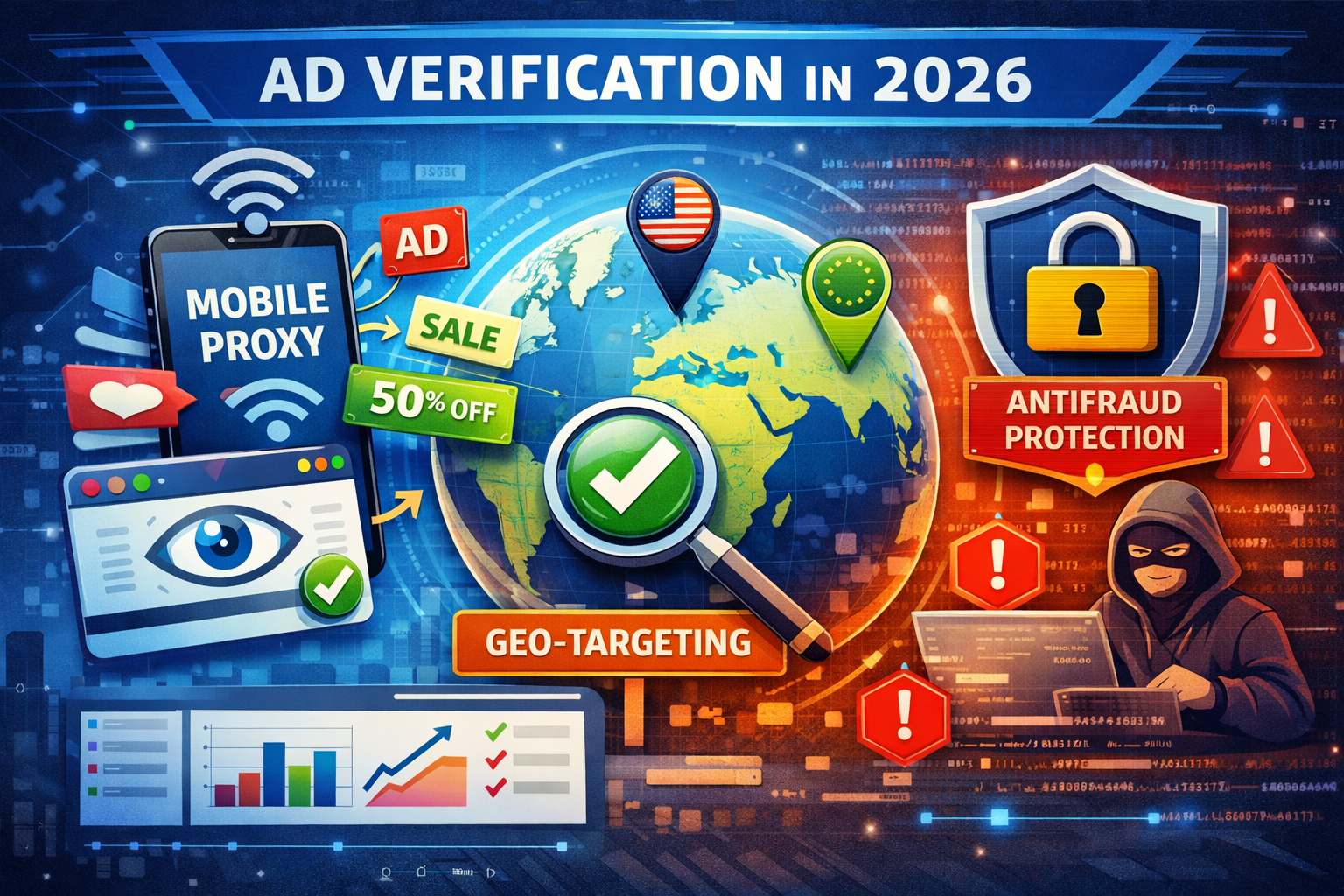
Proxies for Ad Verification in 2026
What ad verification proxies are and why they are needed
Ad verification proxies are essential tools for advertisers in 2026 who want to see how ads are really displayed across different locations, devices, and networks. Using ad verification proxies allows marketers to check geo-targeting, creatives, and ad placement without distorted results caused by antifraud systems.
Why Ad Verification Proxies Are Required in 2026
Ad Verification is the process of checking:
- where ads are shown;
- whether campaigns match their targeting settings;
- if creatives or offers are being replaced;
- whether geo-targeting and mobile delivery work correctly.
In practice, sophisticated anti-fraud systems on advertising platforms analyze IP addresses, connection types, and behavior patterns — which makes proxies an essential part of accurate verification.
Why mobile proxies are preferred for ad verification
Advertising platforms distinguish between IP types. Mobile IP addresses appear as real traffic from smartphone users, which means they tend to:
- face fewer restrictions and blocks;
- provide more accurate geo-targeting results;
- display mobile ad content as real users see it.
To learn more about the technical foundation and real usage of mobile IPs, see Mobile Proxies: An Effective Solution for Arbitrage, SMM, Scraping, and More.
Ad stability and campaign control: the role of IP rotation
When verifying ads across multiple regions and creative versions, repetitive activity can look suspicious to anti-fraud systems. To reduce this risk, proxy services often provide IP rotation, where the outgoing IP changes regularly to mimic organic user behavior.
To understand this concept more deeply, see Mobile Proxies with Rotation: Features and Benefits.
How websites detect mobile proxies and why they trust them
Even with mobile IPs, platforms still evaluate multiple signals — such as network type, request rate, and geographic consistency — to decide how trustworthy a connection is. To learn why mobile proxies are less likely to be flagged than other proxy types, see How Websites Detect Mobile Proxies and Why They Trust Them.
Proxy protocols that work best for ad verification
Different proxy setups use different protocols like HTTP, HTTPS, or SOCKS5. Choosing the right protocol affects compatibility with apps, browsers, and automated tools. For a clear comparison and recommendations, see HTTP, HTTPS, and SOCKS proxies: what’s the difference and which one to choose?
Where proxies are used alongside advertising tasks
Ad verification is rarely used in isolation. Proxies are also essential for tasks like geo-targeted scraping, account management, and regional testing. For example, Spanish Mobile Proxies: A Practical Choice for European Online Projects illustrates how location matters when working with European audiences.
Optional related link (affiliate context)
While not directly about ad verification, many professionals also leverage affiliate programs related to proxy services. You can explore the Affiliate Program for Selling Mobile Proxies to understand how industry professionals monetize proxy usage.
Final thoughts
Ad verification proxies in 2026 are an essential tool for marketers and advertisers who want:
- accurate ad delivery insights;
- correct geo-targeting checks;
- minimized anti-fraud interference;
- scalable monitoring without blocks.


