

 English
 Русский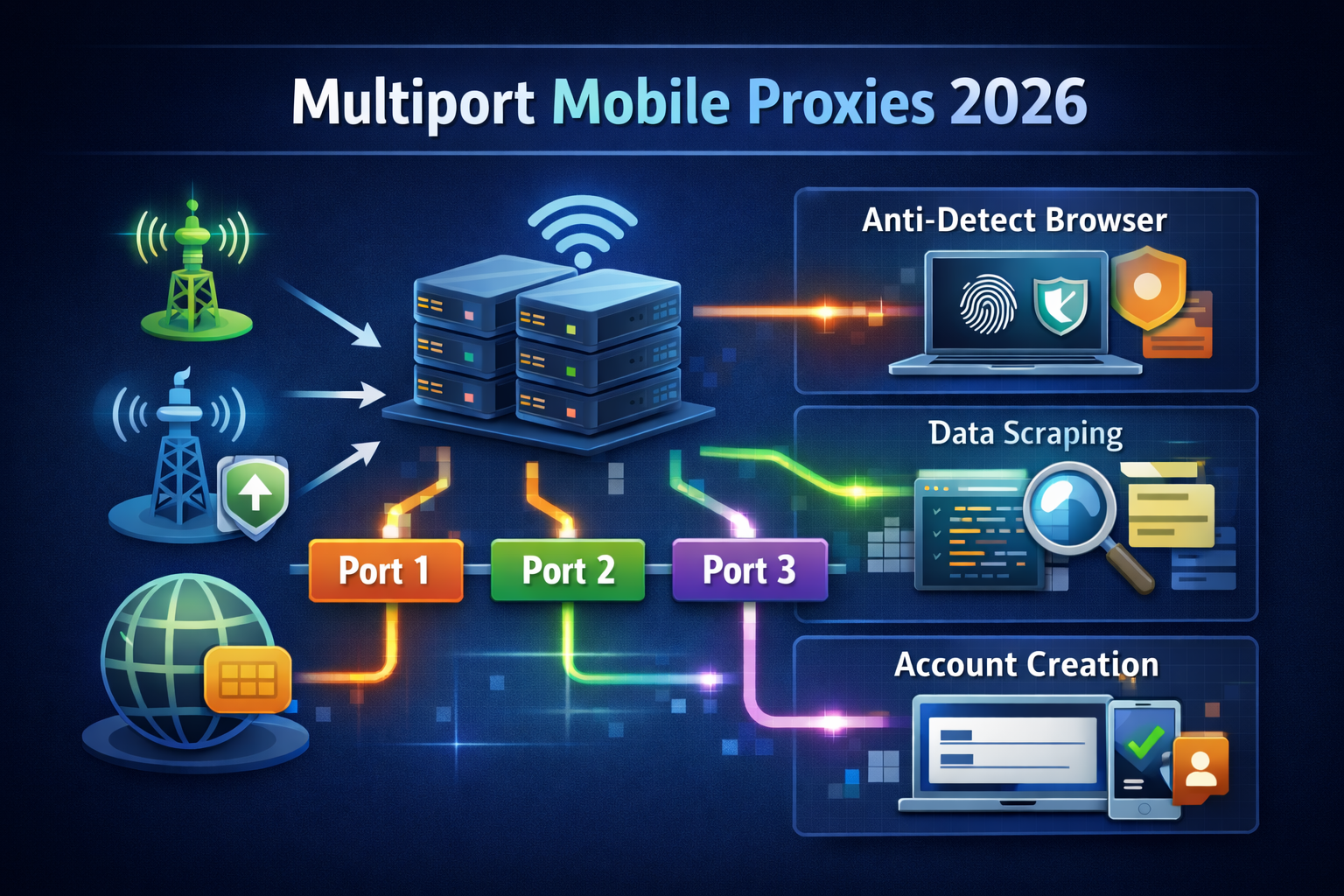
Multiport mobile proxies in 2026 are widely used in projects where a single IP connection is no longer sufficient. Automation workflows such as data scraping, account registration, anti-detect browser sessions, and account farming require multiple parallel network streams. Instead of sending all requests through a single mobile IP, multiport infrastructure distributes traffic across several proxy ports connected to mobile networks.
This architecture allows projects to reduce traffic concentration, manage sessions more precisely, and minimize patterns that anti-fraud systems can detect.
Problem Overview
Modern platforms rely on advanced anti-fraud systems that analyze network behavior rather than only checking the IP address. These systems evaluate multiple parameters including request frequency, connection history, session duration, ASN reputation, device fingerprint signals, and geographic consistency.
When automation tools operate through a single proxy endpoint, the pattern becomes predictable. Repeated requests from the same network channel create abnormal activity signals that anti-fraud algorithms easily detect.
For projects that perform large-scale automation tasks, multiport mobile proxies help distribute activity across separate ports, reducing traffic overlap and improving network isolation between sessions.
Understanding IP rotation in mobile proxies is also important when working with multiport architecture.
Another important factor is understanding how websites detect mobile proxies.
How Multiport Mobile Proxies Work
Multiport mobile proxies provide several connection ports that link to mobile network IP pools. Each port acts as an independent access channel, allowing different tasks or automation streams to run simultaneously without sharing the same direct connection.
Technically, this setup provides several advantages.
The first advantage is traffic segmentation. Instead of sending all requests through a single endpoint, each automation process can use a dedicated port. For example, one port may handle account creation, another scraping tasks, and another session verification.
The second advantage is session isolation. When working with anti-detect browsers, isolating profiles at the network level reduces overlap between digital fingerprints and connection history.
The third advantage is flexible IP rotation management. Ports can operate with different rotation rules such as time-based changes, session-based rotation, or manual switching.
The fourth advantage is load balancing. By spreading traffic across several ports, the proxy infrastructure avoids excessive activity on a single connection channel.
When configuring proxy infrastructure, choosing the correct protocol is also important, especially when comparing HTTP vs HTTPS vs SOCKS5 mobile proxies.
Practical Use Cases
Multiport mobile proxies are commonly used in automation environments where multiple independent workflows operate simultaneously.
The first use case is account creation. Platforms monitor IP activity during registration processes, and repeated account creation from a single network channel quickly becomes suspicious.
Projects that rely on account registration with mobile proxies often separate each registration flow into different proxy ports to avoid traffic overlap.
The second use case is data scraping. Scrapers collecting product listings, advertisements, or search results often generate thousands of requests. Multiport architecture allows scraping tools to distribute requests across several channels, reducing the chance of triggering rate limits.
The third use case is anti-fraud testing and monitoring. Security teams and analysts frequently simulate user behavior across different environments. Multiport proxies help separate these tests so each scenario maintains its own network identity.
The fourth use case is account farming. When managing large groups of accounts through anti-detect browsers, it is important to isolate network sessions. Multiport mobile proxies provide a structured way to assign dedicated proxy ports to different browser profiles.
Why Multiport Mobile Proxies Help With Scaling
Automation projects usually start with simple setups. However, once the number of tasks increases, infrastructure complexity grows quickly.
Multiport mobile proxies allow projects to scale operations without rebuilding network architecture from scratch. Each port can be assigned to specific workflows, automation scripts, or account groups.
Another advantage is geographic distribution. Mobile proxy providers often offer multiple regions, allowing projects to simulate real mobile users from different countries.
In such cases, the geography of mobile proxies becomes an important factor when selecting proxy infrastructure.
From an infrastructure perspective, multiport proxy architecture improves operational stability by reducing request concentration and simplifying traffic management across multiple sessions.
Conclusion
Multiport mobile proxies represent an advanced infrastructure model for automation projects in 2026. By distributing traffic across multiple ports connected to mobile networks, they allow better session isolation, flexible IP rotation strategies, and improved scalability.
For tasks involving mobile IP traffic, anti-detect browsers, account registration, account farming, or large-scale scraping, multiport proxy architecture provides a more stable and manageable environment compared to single-endpoint proxy setups.
While simple projects may not require such infrastructure, scaling automation workflows usually makes multiport proxy systems a practical and efficient solution.


