

 English
 Русский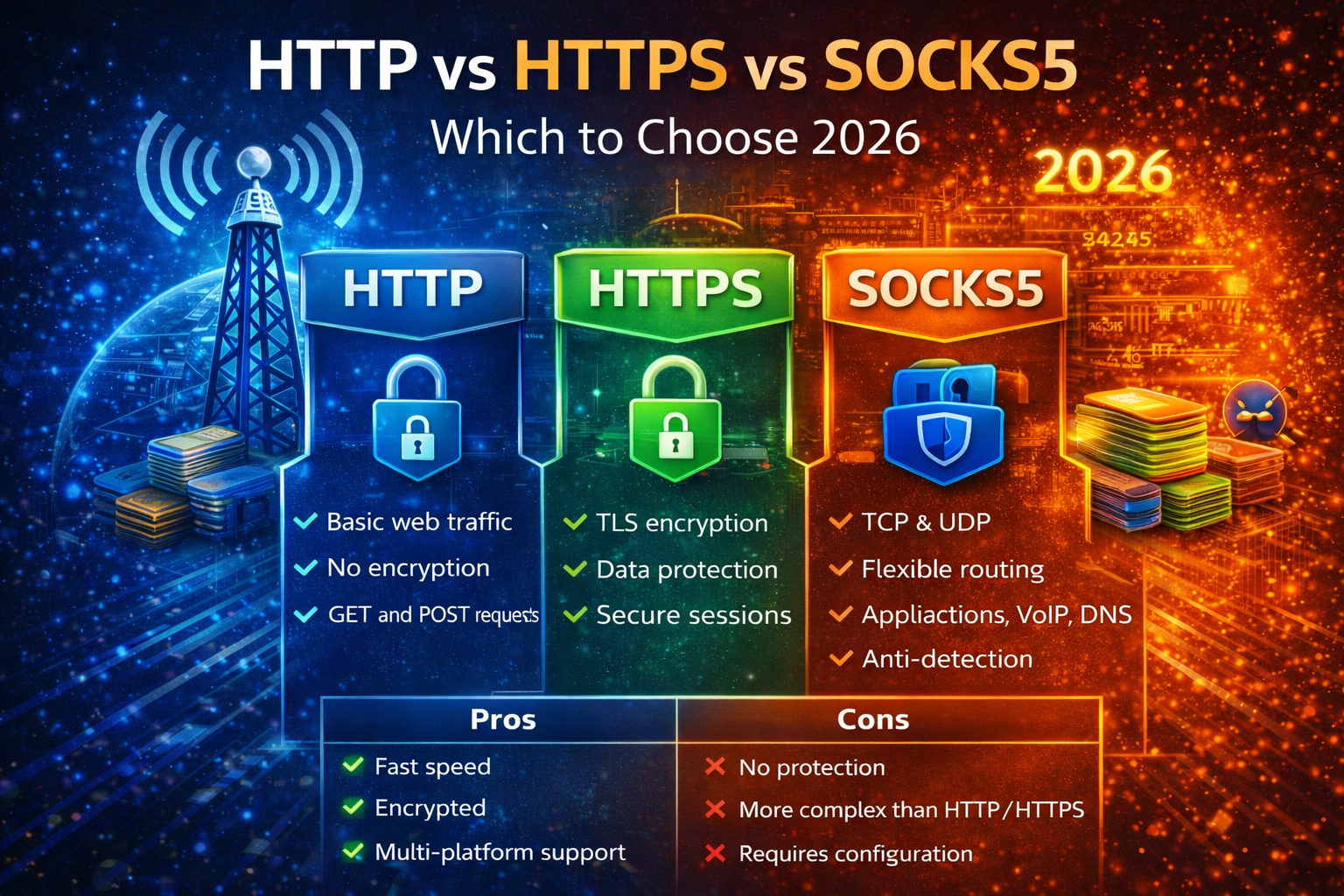
HTTP vs HTTPS vs SOCKS5 is one of the most important technical decisions when configuring mobile proxies for account registration, automation, scraping, and anti-fraud-sensitive tasks. In 2026, platforms analyze not only the IP address but also the protocol type, connection behavior, and traffic characteristics.
Choosing the correct protocol directly affects connection stability, data security, and resistance to detection.
HTTP vs HTTPS vs SOCKS5: Key Differences
HTTP, HTTPS, and SOCKS5 operate at different layers of network communication.
- HTTP works at the web request level.
- HTTPS adds TLS encryption to HTTP traffic.
- SOCKS5 operates at the transport layer (TCP/UDP) and supports broader application traffic.
When working with sensitive platforms, the protocol must align with the network type. This is why scalable infrastructures rely on mobile proxies for anti-fraud protection, where carrier ASN traffic provides higher baseline trust.
How HTTP Works in Mobile Proxies
HTTP is the simplest proxy protocol. It is suitable for:
- standard browsing
- basic scraping
- testing connections
- simple API requests
HTTP proxies are lightweight and easy to configure. However, they do not encrypt traffic. This makes them less suitable for tasks involving credentials or protected sessions.
In modern environments, HTTP is typically used for non-sensitive operations or testing setups.
HTTPS in Mobile Proxies: Secure Transmission
HTTPS adds TLS encryption, providing:
- protected data transmission
- secure authentication sessions
- encrypted request content
- safer login operations
Most modern platforms require HTTPS-based connections. For account registration, advertising dashboards, and social media logins, HTTPS is often the default recommendation.
For large-scale scraping or search-related automation, distributing traffic through proxies for SEO and web scraping automation helps maintain natural activity patterns.
SOCKS5 in Mobile Proxies: Maximum Flexibility
SOCKS5 operates at a lower network level and supports both TCP and UDP traffic.
It is commonly used for:
- anti-detect browsers
- desktop applications
- Telegram clients
- VoIP services
- complex automation systems
SOCKS5 can also proxy DNS requests, reducing DNS leak risks and improving anonymity.
For advanced multi-application environments, SOCKS5 offers greater flexibility than HTTP or HTTPS.
HTTP vs HTTPS vs SOCKS5 and Anti-Fraud Systems
Anti-fraud engines analyze:
- IP type and ASN
- connection frequency
- traffic anomalies
- regional consistency
- behavioral signals
Using the wrong protocol for a given task may increase scrutiny. For example, non-encrypted traffic patterns may appear suspicious when interacting with secure platforms.
Geographic alignment between IP and target region should always be configured properly via mobile proxy geography options.
When protocol choice, IP type, and behavioral patterns are aligned, detection risk decreases significantly.
When to Choose HTTP
HTTP is appropriate when:
- testing configurations
- accessing non-sensitive resources
- running simple monitoring scripts
- performing lightweight scraping
However, for login-heavy workflows or registration processes, HTTPS or SOCKS5 is typically more suitable.
When to Choose HTTPS
HTTPS is recommended for:
- account registration
- secure dashboards
- authentication workflows
- handling sensitive data
In 2026, HTTPS has become the standard for most browser-based proxy usage.
When to Choose SOCKS5
SOCKS5 is optimal when:
- using anti-detect environments
- running automation software
- routing non-browser traffic
- managing multi-application workflows
It provides flexibility and compatibility beyond traditional web-based tasks.
Practical Decision Model for 2026
For most standard web operations → HTTPS
For complex automation → SOCKS5
For testing and lightweight tasks → HTTP
However, protocol choice alone does not guarantee stability. The IP network type remains critical. Even perfectly configured SOCKS5 connections cannot compensate for low-trust datacenter IPs.
This is why mobile proxies remain the foundation of high-trust infrastructure.
Why Mobile Proxies Support All Three Protocols
LTESpace mobile proxies support HTTP, HTTPS, and SOCKS5, allowing:
- flexible infrastructure design
- task-based protocol selection
- stable multi-platform compatibility
- reduced detection risk
The protocol becomes part of your architecture rather than just a connection setting.
Conclusion
HTTP vs HTTPS vs SOCKS5 is not just a technical comparison. It is a strategic decision affecting security, compatibility, and anti-fraud resistance.
In 2026, selecting the correct proxy protocol requires aligning:
- task type
- traffic behavior
- automation level
- security requirements
When combined with carrier-based mobile IPs, the right protocol ensures stable and scalable operations.


